Demolition planning
Record demolition waste streams
Keep measured quantities, material descriptions, receiving-site acceptance and haulage responsibilities as separate parts of the plan.
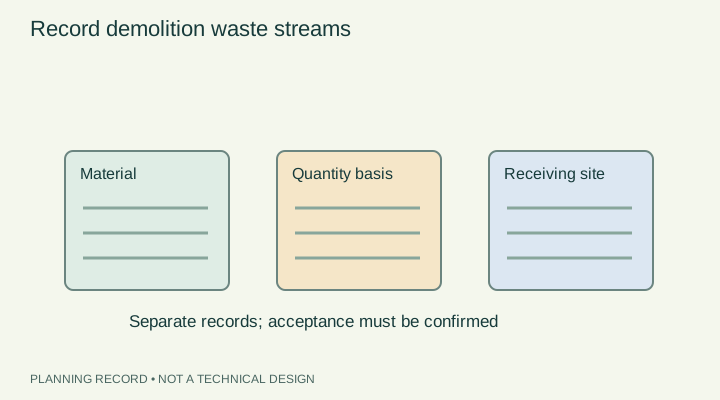
Describe each material stream
List the materials expected from the proposed work and say where the information came from: a drawing, an assessment, a contractor estimate or an observation. Keep unknown mixtures and suspect materials clearly identified. A concrete-volume calculation measures a geometric quantity; it does not establish contamination status, waste classification or the amount a carrier may transport. Do not combine specialized waste with a general disposal assumption merely because it occupies the same room.
Reference context: City of Calgary — Common business waste disposal · Alberta — Asbestos Abatement Manual
Use entered dimensions with limits
The material-volume converter multiplies area by entered thickness after converting the selected units. It records the values and the arithmetic so the scenario can be checked. The result is solid geometric volume only. Voids, reinforcement, other materials, breakage and loose-volume changes are not inferred. If you need a disposal estimate, ask the responsible contractor or receiving facility what measurement basis and material information they require.
Reference context: City of Calgary — Common business waste disposal
Confirm acceptance at the time of use
A nearby facility is not automatically able to receive every material or load. Calgary's business-waste and specialized-disposal pages illustrate why receiving-site rules belong in the planning record. Acceptance, bookings, permits, charges and operational availability can change. Record the facility's dated answer, the material description supplied and any documentation requested. Do not treat a saved web page or an old quote as a current acceptance confirmation.
Keep units in every quantity column. A drawing-based square-metre area, a calculated cubic-metre solid volume and a carrier's proposed load count are different records. Write the conversion or supplied assumption explicitly if one is used to connect them. This makes it possible to revise a quantity without silently altering the material classification or transport plan.
Reference context: City of Calgary — Common business waste disposal · City of Calgary — Asbestos disposal · City of Calgary — Clean fill disposal
Keep transport and receipts visible
The container scenario uses a loose volume and capacity entered by the visitor to show a simple count. It does not determine payload, road compliance, safe loading or an actual delivery arrangement. Ask the carrier to confirm the appropriate container and transport conditions. At close-out, retain the receiving receipts and exception notes required for the project. A written responsibility for those records helps prevent disposal evidence from becoming an unresolved assumption after removal.
Use separate entries for a quantity measured from a drawing and a loose-volume figure supplied by a carrier. Preserve their different units and bases. If the quote uses a load count rather than volume, ask what conditions that count assumes instead of silently converting between unlike measures.
Reference context: City of Calgary — Common business waste disposal · Hiring a contractor — Government of Alberta